
 Courtesy of Van Dam Custom Boats
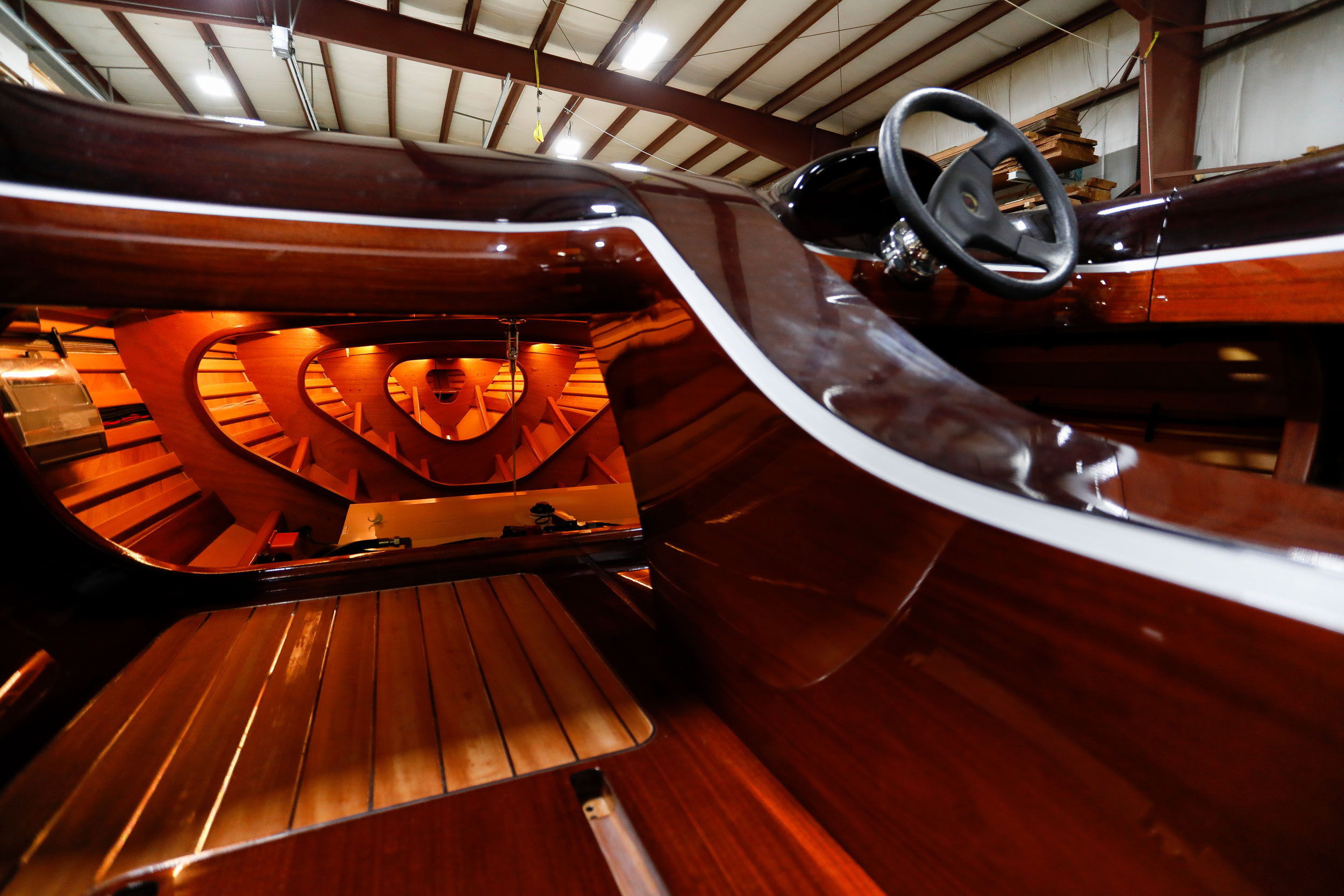
The helm station and illuminated bow compartment on Victoria Z, a 35′ (10.6m) Michael Peters-designed stepped-vee ventilated tunnel (SVVT) speedboat, typifies Van Dam’s equal attention to details in the boat’s flawless finished exterior and the exposed interior hull structure.
If you haven’t heard of Van Dam Custom Boats (Boyne City, Michigan) before now, feel no shame. It’s a company that eschews the modern mercantile tactic of puffing up a brand name to carry the company reputation to hordes of people who have never seen the actual product. For the name to mean anything, you need to actually encounter the boats and the people who create them. With just 66 hulls built since Steve and Jean Van Dam founded the company in 1977, chances are slim you’ve ever run across one of them in the wild.
Before visiting the shop last February, I’d seen their work pictured in a few specialty magazines. I got to know Steve and Jean’s son and current company president, Ben Van Dam, at IBEX and while serving on a boatbuilding school advisory panel. We’d talked about projects, materials, and the vagaries of running a small custom boat shop in the 21st century, but Ben’s unerring modesty about his yard left me unprepared for what I found in Boyne City.
 Courtesy of Van Dam Custom Boats
From astern, Victoria Z is a showcase of molded wood curves and custom metalwork including the twin gunmetal finish outboard rudders and stainless spoon exhausts.
Financial expedience dictates that, like most comfortable middle-class Americans, I am not a regular consumer of bespoke luxury goods. Sure, we all might have a few mass-produced luxe branded trinkets in a closet, or some custom furniture or even small boats made by talented friends, but we possess very few items of truly extraordinary quality, and none of us suffers for the lack. To be blunt, today’s Van Dam boats are not built for us, but they are built by people like you and me to meet the expectations of those who can afford to aspire to near perfection in a one-of-a-kind boat of their imagining.
The Van Dam palette comprises exotic smooth and figured woods, soft textured leather, etched metalwork, graceful curves, and flawless clear and opaque coatings. Each project is defined by personal expectations, materials, finishes, and custom machining I’m accustomed to finding exclusively in superyacht yards. But instead of 300-footers, Van Dam boats average in the 40-foot (12.1m) range.
 Courtesy of Van Dam Custom Boats
This figured redwood burl set in stainless trim is a recurring visual theme on the new 26′ (7.9m) bowrider Arline.
The snow-covered winter roads I navigated through Boyne City, a city of 4,000 on the shores of frozen Lake Charlevoix, were a reminder that we’re not in Viareggio or Fort Lauderdale. But Van Dam’s tidy industrial headquarters wouldn’t be out of place in any superyacht haven. Lobby and conference-room furnishings showcase the company’s joinery and finish, shelves hold samples of custom hardware, and the walls a tempting gallery of boat photos—all Van Dam builds. Looking at them, I had an inkling of what prospective clients experience when they walk through the doors full of hopes and inspiration and a nagging question as to whether these people can build the boat they are dreaming of. The gallery puts their minds at ease.
Van Dam Design Experience
“They come to us because they want a boat built by us,” Ben says. “But we’re not an everyday brand.”
The company counts on word-of-mouth owner references and the boats themselves to find new clients. However, this is not a process that starts with an existing model Van Dam just stretched or tweaked into a slight variation thereby minimizing risk, design work, and innovation. Indeed, one of the company’s selling points is assurance that every boat is built to a client’s specifications and taste and that they won’t build the same model for anyone else—guaranteed unique.
So, after determining the basic use case for the new design, prospects bring pictures of boats they like, accounts of experiences on boats they didn’t like—bad sight lines, balky steering, lack of cupholders—and some design elements from cars or houses they want to replicate. They assemble mood boards of stylistic elements, things clients admire, things that excite them. “We’ve literally gotten a picture of the Batmobile illustrating an element they prefer on the dash,” Ben recalls. These drips of information and inspiration all narrow the focus.
This first stage, paid for at a flat fee, seems as much psychotherapy as boatbuilding. Ben says the hard work is learning to listen and making sure the owner’s wishes are clear before you start designing a boat, and then to not hijack the process in the shop once the design and build are under way.
“It’s our job to understand what the customer is trying to create. It’s our job to figure out what that boat is,” Ben says.
A glance at the photo gallery confirms that there isn’t really a Van Dam type. Ben credits the quirkiness and diversity of customer preferences with driving the shop outside of a comfortable steady diet of classic runabouts or the sailboats that defined some of their early projects.
It takes between two months and a year of regular or sporadic consulting to complete a concept design—plan and profile sketches and color renderings. By then, everyone has a good sense of what the boat will look like.
“That experience becomes a big chunk of what they are excited about,” Ben says.
 Wally Wallace | Professional BoatBuilder Magazine
The helm and cockpit of the 30′ (9.1m) runabout Catnip reflect her owner’s passion for Art Deco styling in the trim, custom instrument panel, and banjo steering wheel, all built in house.
The next stage involves a project manager and relevant in-house specialists weighing in on how some of the design ideas could be executed. It’s also when clients sign a design and build contract.
“Usually by the time they get here, they’ve emotionally made up their minds,” Ben says.
Refining shapes and modeling structures is high-stakes work, and while Ben and Thomas Motyka are degreed in-house naval architects, this is when they engage an outside naval architect if necessary. Especially for high-speed, high-performance boats Ben embraces working with experienced specialists like Michael Peters Yacht Design in Sarasota, Florida, and DLBA Naval Architects of Chesapeake, Virginia.
“That has proven to be a healthy thing,” Ben says. Relying on Peters’ or DLBA’s offices for design and engineering especially with stepped hulls is a practice that protects and prods the Van Dam crew. Ben points to the 1998 build of the Peters-designed Alpha Z, a 33′ (10m) stepped-hull, 805-hp surface-drive runabout, as a build that pushed the shop to a higher level of quality, innovation, and performance.
“Michael Peters took us up to another level,” Steve recalls. “Complexity of design, the engineering of mechanical systems, the drive system, the style, the degree of perfection that was asked for, even the kind of finishes used. It wasn’t going to be brushed varnish.”
“It’s the epitome of timelessness.” Ben says. “That boat is still cool in 2026. It changed the trajectory of our business.”
Alpha Z was also the last boat they lofted manually, Ben recalls. Now he and Motyka, who graduated from Webb in early 2025, rely on 3D modeling in the Van Dam design office where they primarily support whatever build is under way, producing detailed drawings to move the design into reality. Motyka contrasts his work at Van Dam with experience designing for production builders: “Here ergonomics and style can fully drive how we’re going to build something, as opposed to having manufacturing driving it…where the angle of every single face is determined by that.”
Freedom from the tyranny of mold draft angles is one of the essential differences that defines the look and style of a Van Dam. Indeed, the boats are devoid of the hallmarks of production manufacturing—flat expanses of white gelcoat, off-the-shelf electrical panels, throttle controls, or through-hull hardware. The tradeoff is that every defining custom-carved dash, fabricated helm seat, or popup cleat is a time sink.
A Brief History
Behind the business and design offices is the main build hall comprising three 80′ (24.3m) bays, where Ben introduces me to Thor Purinton, who’s fitting the wood armrests to polished stainless upright supports for seats on the new 26′ (7.9m) bowrider Arline. Nearby, sculpted dashboard panels of redwood burl are being fitted to custom stainless elements. It’s all fussy work with very expensive materials. Purinton, a 2002 graduate of the small boats program at the recently defunct Landing School (Arundel, Maine), has worked at Van Dam for 23 years. On top of superlative boatbuilding and joinery skills one co-worker describes as “insane,” he has become the company’s CAN bus expert designing, installing programming, and troubleshooting complex digital switching systems.
 Aaron Porter
Thor Purinton assembles intricate wood and stainless armrests for Arline in the main build hall.
“I get bored very easily,” Purinton explains. “Variety is what keeps me coming back.” That’s a common sentiment in this custom shop’s staff of 25.
“If we had to do the same thing over and over again, I’d probably lose half the crew,” says Ben. “It’s just not how we’re wired.”
The company has always focused on solving boatbuilding problems rather than optimizing production manufacturing processes. Steve, who received the bulk of his boatbuilding education in four years working under legendary builder Vic Carpenter in Port McNicoll, Ontario, was an early proponent of wood/epoxy construction. While most builders in the 1970s were embracing molded fiberglass, and consumers were leery of wood’s reputation for rot, Steve Van Dam opened his doors in the resort town of Harbor Springs, Michigan, to build custom boats in multiple layers of epoxy-saturated wood veneers. In that simple shop with a table saw, bandsaw, and planer, Steve and Jean built their first commissioned boat, the 30′ (9.1m) double-ended cutter Silvan, which launched in 1980 and is now back in the Van Dam service fleet 46 years later.
While some early wood/epoxy boats suffered from water intrusion and rot, Van Dam boats, by and large, did not. As a foil to any concern clients may have about the material integrity of wood structures, the yard still offers what Ben describes as “a lifetime warranty against rot and leaks in anything we built.” That’s contingent on annual inspections and execution of necessary repairs.
Early builds featured a few custom powerboats and numerous sailboats including competitive racing models, but by the late 1980s, a few custom powerboats were introduced “and suddenly it was all powerboats,” Steve says. Van Dam became known for building classic looking speedboats, all varnish and gleaming metal cutwaters, but with the structural advantages of wood/epoxy construction.
 Courtesy of Van Dam Custom Boats
The first commissioned build to emerge from Steve and Jean Van Dam’s Harbor Springs, Michigan, shop in 1980 was the 30′ (9.1m) cutter Silvan.
In 1991, a distressed boatyard property of 16 acres, three buildings, and a hoist well on the Boyne City waterfront became available. Steve and Jean pounced, recognizing the value of having a footprint on the water and the possibility of adding a service yard to their operation.
“It took us a little while to figure out why we should be excited about the service business,” Ben concedes. But now they store about 220 boats in five storage buildings. Their own builds comprise 30% of the fleet cared for by the 12 employees of their independently operated Boyne Boat Yard.
 Courtesy of Van Dam Custom Boats
Steve Van Dam made an early commitment to wood composite construction at a time when fiberglass dominated production boatbuilding.
Through the ’90s and aughts, an elegant series of classic powerboats, quotations of mid-20th-century barrel-backed runabouts, gentleman’s racers, limousine launches, and modern sport cruisers flowed out of the Boyne City shop Chad James, a 32-year veteran of the yard and a regular build team leader, describes the evolution of building through those years as constantly embracing greater complexity. He says simple plans and profiles fitted inside, with boxes of different shapes and some seats attached to them, constituted the design information for early boats. Now, there’s a lot more focus on the intricacies of the helm stations, and the seating itself isn’t just bench seating; there’s custom-shaped foam, and the bases are decorative with stainless steel inlays. Structural and aesthetic elements tie into one another.
“As you get that elaborate, the design has to ramp up as well,” James says. “We want to proof the ergonomics, we want to proof everything, so we build these CNC-cut, full-size mockups and bring the customers in, sit them in the seats, and evaluate every aspect of that station and make adjustments.”
The cold-molded hull structures have become more complex as well, sometimes including a layer of carbon fiber.
 Courtesy of Van Dam Custom Boats
The Van Dam crew builds stiff monocoque hulls by gluing up multiple layers of diagonal fir, spruce, and mahogany planks set in epoxy. Note that the thin planks are all book matched on the port and starboard sides.
“The times we’ve done carbon layup, we haven’t really fallen in love with it,” Ben says. Wood remains their material of choice for hulls and decks, ranging from Sitka spruce, Douglas fir, and Alaskan yellow cedar to multiple mahogany varieties and teak. James recalls that in the 1990s, Steve would buy pattern-grade Honduras mahogany as four-quarter stock, and they’d have it re-sawn and dressed to 1/4″ planking in matched pairs. Today they buy full trees, usually of sipo mahogany, and have it milled to their specifications and re-saw it in house.
“The boats are book matched,” Ben says, describing the hull construction. “All the planking on the starboard side is exactly the same as the port.” Building this visual and structural mirror image requires meticulous logistical recordkeeping.
“We’ve got to document each bit of lumber that comes out of the rack and label it, so when you cut it you still have a label on the cutoff that says where that board was used and its orientation in the boat,” James explains.
Wood for a given build is kept in containers off the shop floor and moved to racks and mobile carts in the build hall when needed. That includes special decorative varieties like that redwood burl I see throughout Arline.
The Finish Shop
We catch up with the new build as she’s being readied for final clear coating by Trevor Brazell, who leads Van Dam’s paint and finish shop. He says the company moved away from using strictly marine finishes about 10 years ago. They weren’t happy with the customer service from some manufacturers, and then automotive coatings specialists Glasurit approached them about trying a sprayed clear coat. The results speak for themselves. The gloss finishes I see, even on older Van Dam builds in the storage buildings, are flawless. Brazell assures me the shop still offers conventional marine paint and varnish as well.
While he praises the Glasurit for durability, acceptable finish right off the gun, and ability to be cut and polished, Brazell gives a lot of the credit to the crews who fair and prep the surface before and between finish coats. He makes sure their attention to detail is obsessive.
“There’s a lot of dirty work behind the scenes,” Brazell says. “And they have a sanding block in their hand every day.”
 © 2026 Van Dam Custom Boats, all rights reserved.
In a shop where varnished finish perfection is standard, fairing and sanding are high-stakes processes with no room for error.
The finish shop is about more than just smooth, clear coatings. Ben explains how they painted an Escheresque fading geometric pattern on the bottom of the 30′ (9.1m) 2024 runabout 5-Star, creating a unique visual transition from a black painted bottom to her wood topsides.
On Arline, he shows me a decorative motif from the owner’s former yacht that reads as a mirage-like shape that will show up when the light hits the varnish of his new boat at the right angle. Inspection of Arline’s engineroom confirms the Van Dam point of pride that all interior surfaces, including those in mechanical and service spaces, are beautifully finished even if they’re rarely seen.
 Aaron Porter
This decorative motif being set in Arline‘s bright finished woodwork will be visible when the light hits it right.
Metal and Machine Shop
A factor that sets Van Dam apart is its custom hardware and fabricated metalwork. It wasn’t always that way. Until the early aughts there was just a small room equipped with a lathe, a welder, and a grinder. Then Jesse Brown joined the company fresh out of the Landing School in 2002. With some prior machining experience, he saw what a better metal shop could mean for the yard. He advocated for a Bridgeport, a bigger lathe, and eventually a CNC machine, all of which is there on the day we visit Brown and technician Kate Brandsma as they finish some custom popup cleats, add cavitation plates to a stainless rudder, and rough out some hinge parts.
“We’ve gone from super simple bracketry and cutwaters—now it’s almost everything,” Brown says. “We buy very little off-the-shelf hardware because we’re able to make whatever we need.
 Aaron Porter
One of Catnip’s rudders, originally CNC-cut from a billet of stainless, in the metal shop for fine tuning.
“I think it gives us that much more creativity and freedom,” Ben says. They’re no longer constrained by subpar off-the-shelf solutions, which is particularly important as the boats become more complex and personalized.
“Today we’re machining every individual button that you press,” Steve says with equal parts wonder and admiration.
Ben shows me a sample of the portlights created for the 44′ (13.4m) Stephens Waring-designed sloop Italmas, built in 2019. He says all readily available portlights suffered from poorly polished castings with a rippled finish and screens held in by “a big, awful gasket.” The custom opening portlights with fitted screens they built in house were CNC cut, fabricated, polished, and fitted with cam closures, not twist locks.
The custom throttle and shifter fabricated for 5-Star highlight the shop’s ability to customize and incorporate existing tech when necessary. The functionality comes from standard Glendinning engine controls, which pair well with the boat’s Ilmor engines, but the visible and tactile levers and surfaces are all Van Dam custom wood and metal.
 Aaron Porter
Kate Brandsma drilling out some custom hinge parts. Almost all hardware is now made in house at Van Dam.
Succession and Future
Custom yards often suffer as their founders age and markets evolve. Not so Van Dam. Steve and Jean knew they’d need to pass yard management off to someone eventually but insisted that Ben go to college before he decided to settle in at the company for the long haul.
There was little doubt about the future in Ben’s mind. He graduated from University of Michigan’s naval architecture program in 2005, drafted a succession plan with his parents, dove back into the build shop, was named company president in 2016, and, with his wife Erika, took ownership of the yard in 2020, following a protracted planned buyout of his parents. Today, he and Erika, who worked running a public health organization until five years ago, share management responsibilities at Van Dam. He oversees the shop and build operations, while she handles the business office, forecasting, HR, and bookkeeping. Ben says his last hands-on project as a build leader was Victoria Z, a 35′ (10.6m) Michael Peters-designed stepped-vee ventilated tunnel (SVVT) speedboat launched in 2025. There are days when he misses it.
 Courtesy of Van Dam Custom Boats
Erika and Ben Van Dam
Their challenges will be familiar to any boatbuilder in 2026: how to implement strategic measures with a small team, employee recruitment and retention, affordable housing, cost and sourcing of materials, market dynamics, client expectations…
Van Dam has been an open-book company since 2012. That, coupled with profit sharing, means employees are informed and invested in overall performance. The number of 20- and 30-year employees I met tells me something about the steadiness of the workplace and company culture. Ben and Erika say recruitment is a mix of prospecting from boatbuilding schools like the Marine Trades Institute (Cedarville, Michigan), promising high school graduates, and skilled workers from related trades looking for a challenge. Working interviews are mandatory.
They agree that intelligence and fitting into the company culture are as important as specific skills, and complacency isn’t part of the company culture. There will be problems to solve every day, and collaboration is not optional. When it comes to workforce, “subpar won’t do. We’re just driving too hard,” Ben says. “We couldn’t build a 30-footer for the same labor hours we build one for 20 years ago because we’re focusing now on a higher bar.”
As those build standards have risen, so have the dreams and expectations of the average Van Dam client. Which rose first? Who knows. What’s obvious when you look at the historical builds is the newest boats consistently define the next level, and the trajectory is always up.
 Courtesy of Van Dam Custom Boats
The comfortable, well-lit interior of the 44′ (13.4m) Stephens Waring-designed sloop Italmas is typical of the yard’s cruising sailboats. Note the custom opening portlights.
About the Author: Aaron Porter is editor of Professional BoatBuilder magazine