
 Brendan Bullock, Courtesy MOF
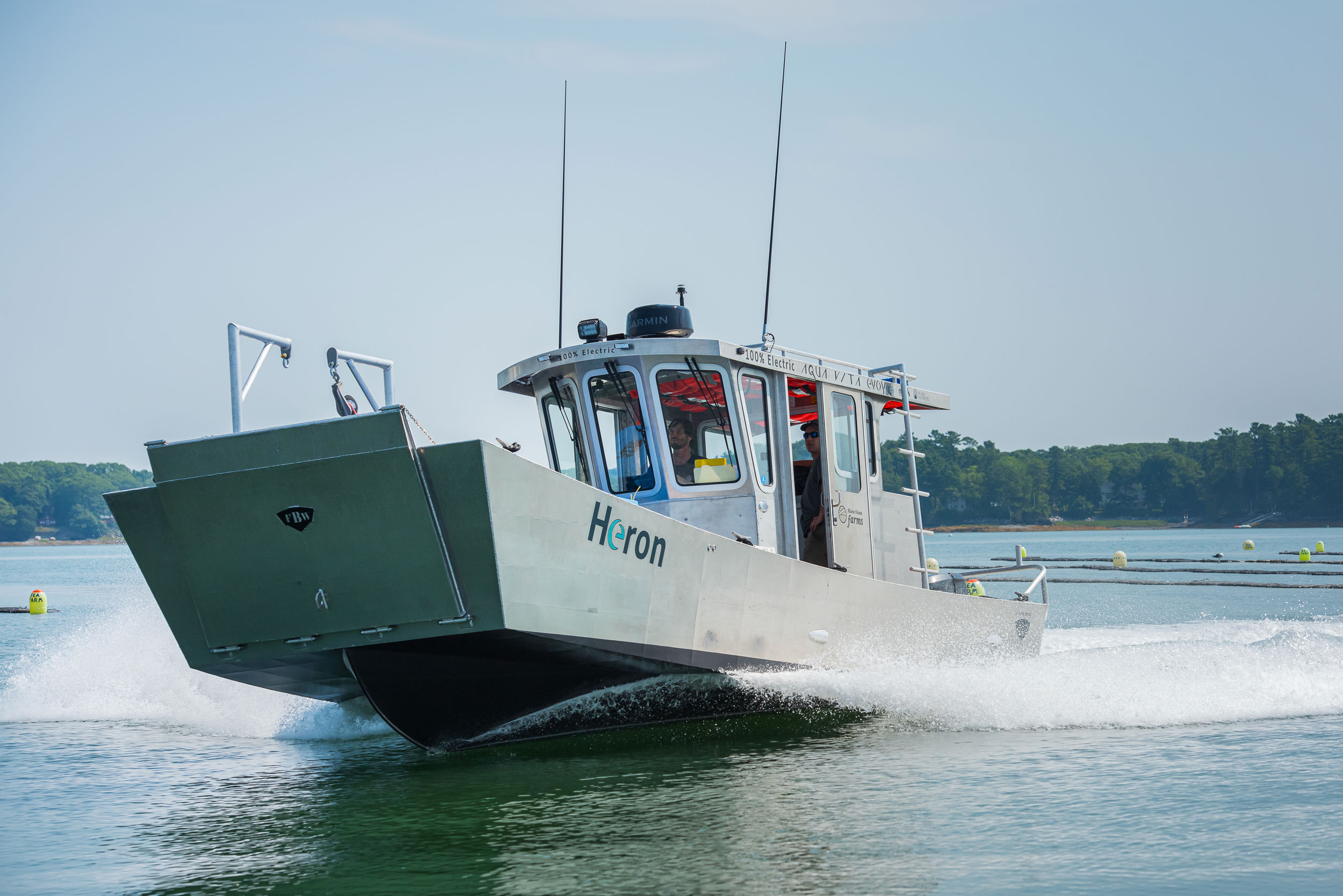
 The electric-powered Heron, designed and built by Fogg’s Boatworks for Maine Ocean Farms, is a burdensome but nimble work platform capable of running at 20 knots.
Fogg’s Boatworks embraces the latest in electric propulsion as it delivers practical metal hulls for work and pleasure.
Anyone who has ever used a backing-out plane or an oyster knife knows the pragmatic beauty of a tool perfectly suited to its purpose—a tool with a specific intended use that does exactly what it’s supposed to, with as little fuss and wasted capacity as possible. I find a similar practical aesthetic appeal in the no-nonsense, welded aluminum workboats common in government agency and demanding commercial services like search-and-rescue, windfarm tenders, and fishing.
Perversely, despite their ubiquity in the Pacific Northwest and popularity along the Gulf Coast, these admirable aluminum vessels have never been numerous on the foggy coast of Maine. It caught my attention when a trickle of new aluminum workboats started showing up over the last few years, some from the West Coast, but many of them built in-state by Maine boatbuilders Lyman Morse and Fogg’s Boatworks.
My interest ratcheted up when I noticed how many of these vessels are ultra-stable landing-craft models, equipped with bow ramps for beach loading and designed to serve as tenders for aquaculture operations like oyster and kelp farms. When a series of anomalous winter storms and seasonal high tides damaged or destroyed hundreds of Maine wharves in 2023, the utility of landing craft capable of serving coastal communities directly from beaches became even more apparent.
The price of a nimble new 28′ (8.5m) utility boat that can be moved out of harm’s way as threatening weather approaches pales in comparison to the expense of permitting and rebuilding a fixed pier that remains vulnerable to rising sea levels and volatile weather patterns.
 Courtesy Fogg’s Boatworks
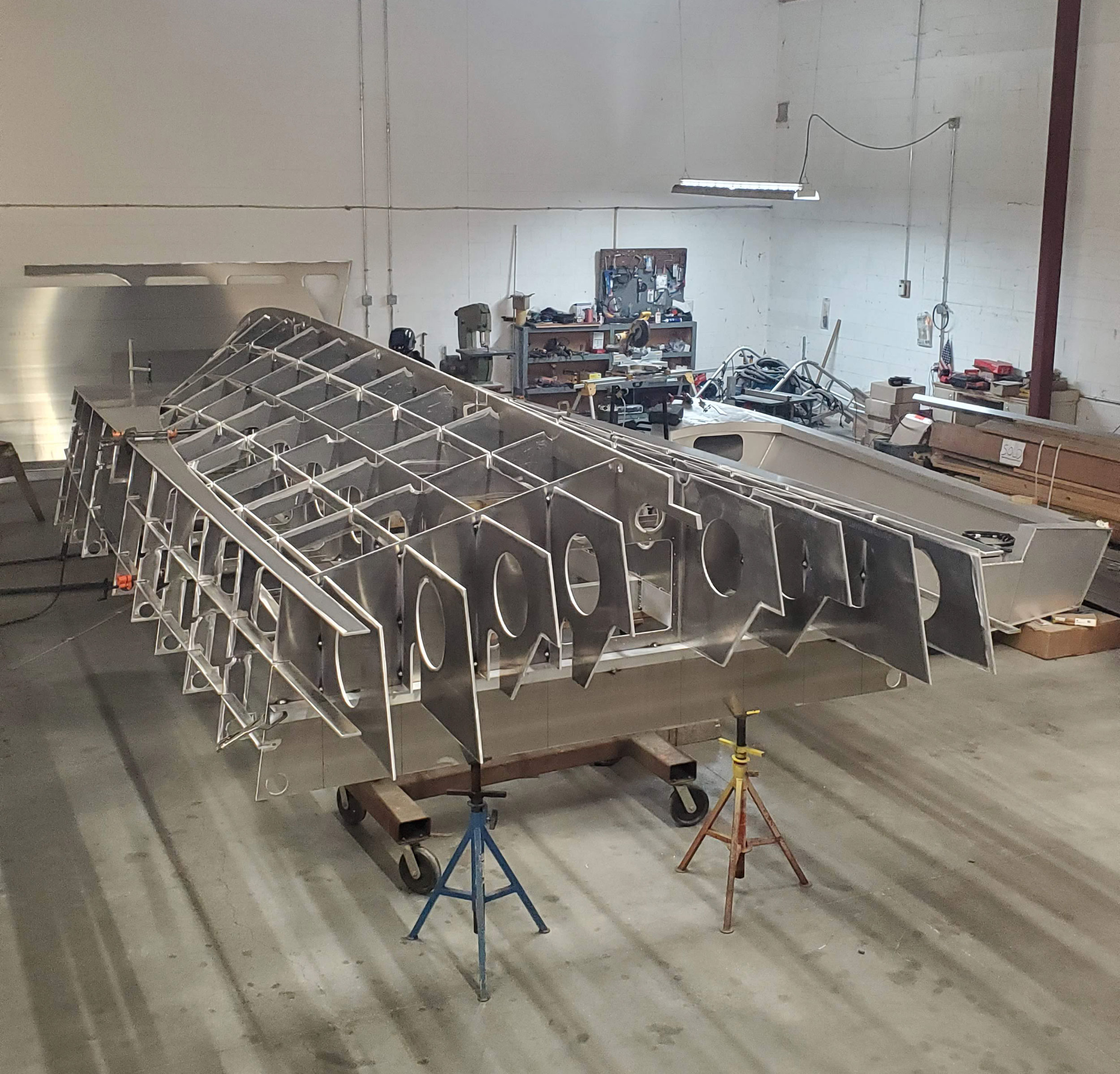
 Heron‘s CNC-cut aluminum structural grid takes shape.
Fogg’s Shop
That rough calculation prompted a visit to Fogg’s Boatworks in North Yarmouth, Maine, where Dennis Fogg—now joined by his son, Patrick—have been building welded aluminum boats since 2000. Dennis grew up navigating the fine line between work and play on Casco Bay, taking up lobstering at 15 in a 28′ wooden boat and later training as a boatbuilder at the now-defunct Boat School in Eastport, Maine, in the late 1970s. Upon graduating, he spent five years in San Diego building mostly cold-molded wood boats at Kettenburg Marine before returning to southern Maine in the mid-1980s to work for local boatbuilders and service yards.
A decade later—firm in the knowledge that he didn’t want to work with a boss or fiberglass any more than he had to—Fogg was running his own shop. He had serviced several aluminum boats that impressed him and completed a brief apprenticeship at the naval contractor Bath Iron Works, where he worked with a weld-quality inspector. While he knew what good fabrication looked like, it wasn’t until 2000 that he built an aluminum boat to his own design.
“Two things bothered me about a boat—you couldn’t see over the bow at half speed and accessibility of fuel tanks (for maintenance),” he said. To combat the first, he opted for a long, narrow hullform that’s easily driven and doesn’t dig a hole before popping onto a plane but simply rises as speed increases. For the second, he placed accessible tanks along the boat’s centerline—a design hallmark that remains central to Fogg boats even as operation of the company has passed to Patrick, also a Boat School alumnus.
The first Fogg boats were built on spec and became part of a water taxi service serving Casco Bay. “One of the reasons we started up the water taxi was to show off our boats,” Dennis said. Their fleet now includes six Fogg-designed and built boats, including a Coast Guard-certified 46′ (14m) catamaran. Before long, clients looking for custom aluminum boats came knocking.
In the modest room that passes for a design office in Fogg’s build shop in North Yarmouth, Patrick walked me through a recent design for a 27′ (8.2m) outboard cruiser he was finalizing. Using Rhino 3D design software, he was nesting cut files for custom parts on standard aluminum plate stock to be sent to the CNC laser-cutting contractor. Blue lines indicated full cuts, while red marked shallow etched marks that would remain on the plate to guide assembly. Patrick learned boat design at a drafting table with splines and weights, but like most of his contemporaries, he has shifted entirely to Rhino for almost all design development. That doesn’t mean there’s no art left in the process.
 Courtesy Fogg’s Boatworks
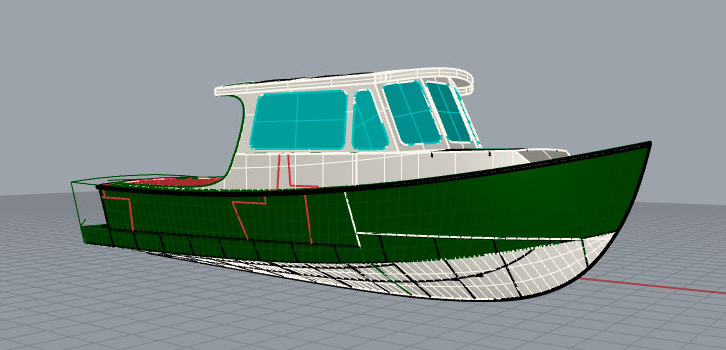
 Refining the bow sections of a new Fogg design in Rhino.
“This is the first time I’ve done sort of a curved plate,” Patrick confessed as we looked at the fine bow sections of the boat on his screen. “I tried to sweep up the front to give it a nice curve, but the program doesn’t like it. It tells you what it thinks is a little inaccurate.” But Patrick’s experience tells him that he can torture the flat plate into a curve that challenges the theoretical bounds of a developable surface the computer adheres to. Building on a jig upside-down on the shop floor, he knows he can coax the aluminum to do a little more than the computer calculates. “It’s stuff you can do with the push of a hand,” he explained.
Finalizing the files is a complex high-stakes part of the process when Patrick wants to include as much of the cutting as possible, thereby minimizing the need for adjustments on the shop floor. That means, in addition to the essential structural elements and plate curves, he has spent a lot of time planning where all hatch openings will be, as well as cutouts for fuel lines, vent lines, and electrical chases. If he gets it right, the pallet of cut aluminum that arrives from the CNC shop is a virtual kit that requires only assembly and welding.
 Aaron Porter
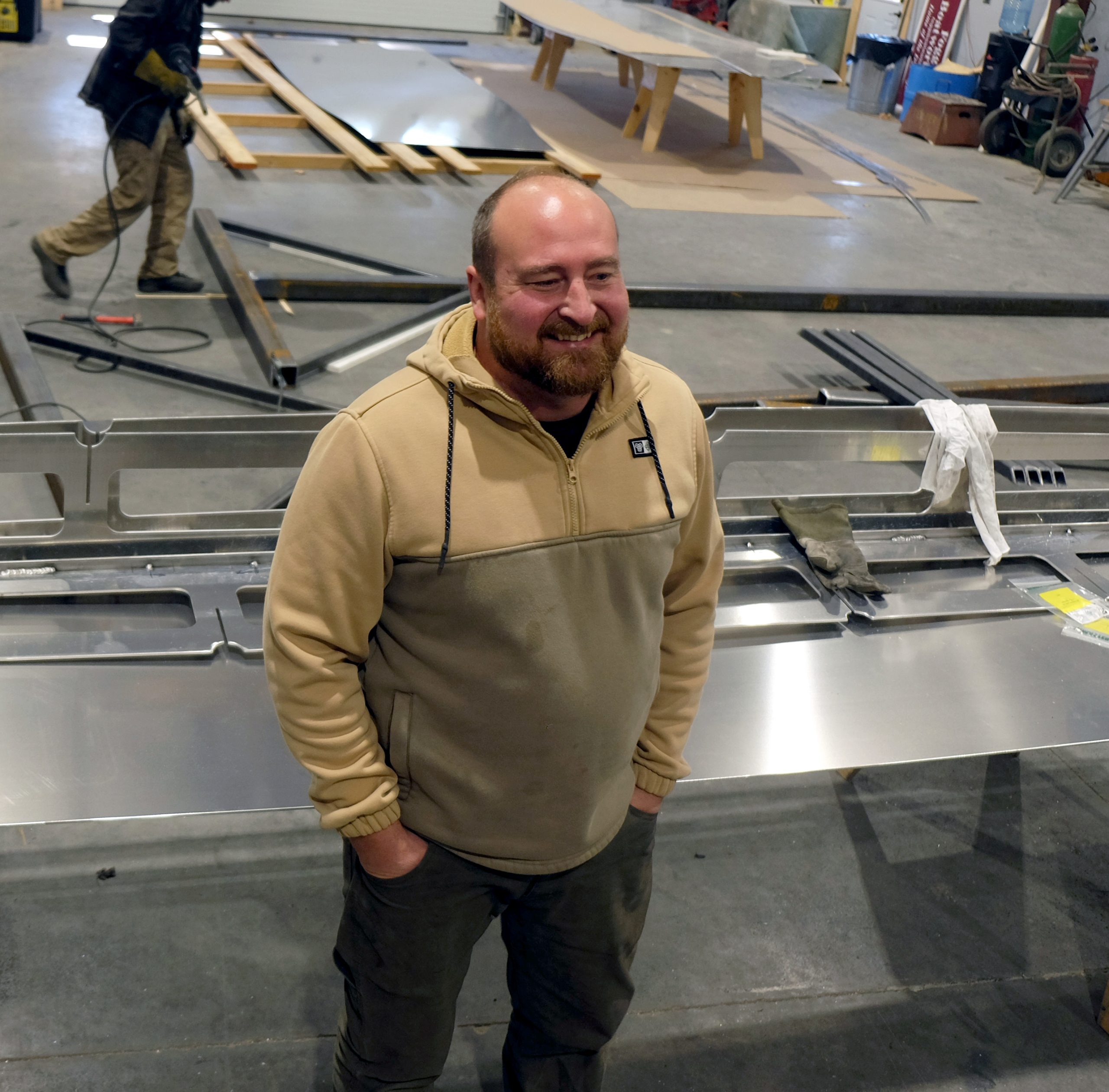
 Patrick Fogg on the shop floor.
One of the great advantages of working in Rhino software to refine every new boat is the ability to make changes to accommodate a client’s needs right up until the cut files are sent. “You’re not stuck with a mold,” Patrick said. “This method of building is really good for that. It’s easy to make a change. They’re not just building a standard boat. If they say, ‘In my perfect world, I want my boat to do this,’ we can try to hit all those parts.”
Heron
In September 2024, a new client came through the door with a request that changed the trajectory of Fogg’s for at least the next couple of years. Maine Ocean Farms, a Brunswick, Maine-based aquaculture company, was looking for a new work platform to tend its nearly 10-acre (4-hectare) oyster farm, and it had to be powered electrically.
Willy Leathers, co-founder and director of farm operations, explained that the boat was part of a federally funded pilot project aimed at introducing dockside fast charging to Maine, deploying electric propulsion to a commercial fish farm, and developing a working farm tender compatible with electric propulsion. The demonstrator project, coordinated by the Island Institute (Rockland, Maine), was to use Aqua superPower’s fast charger, which requires 480V, 3-phase, 300-amp shoreside service. (The charger was installed at the Gulf of Maine Research Center’s Portland waterfront wharf in early November.) Propulsion for the boat was to come from twin Evoy electric outboards rated for 120 continuous horsepower and higher short bursts.
 Aaron Porter
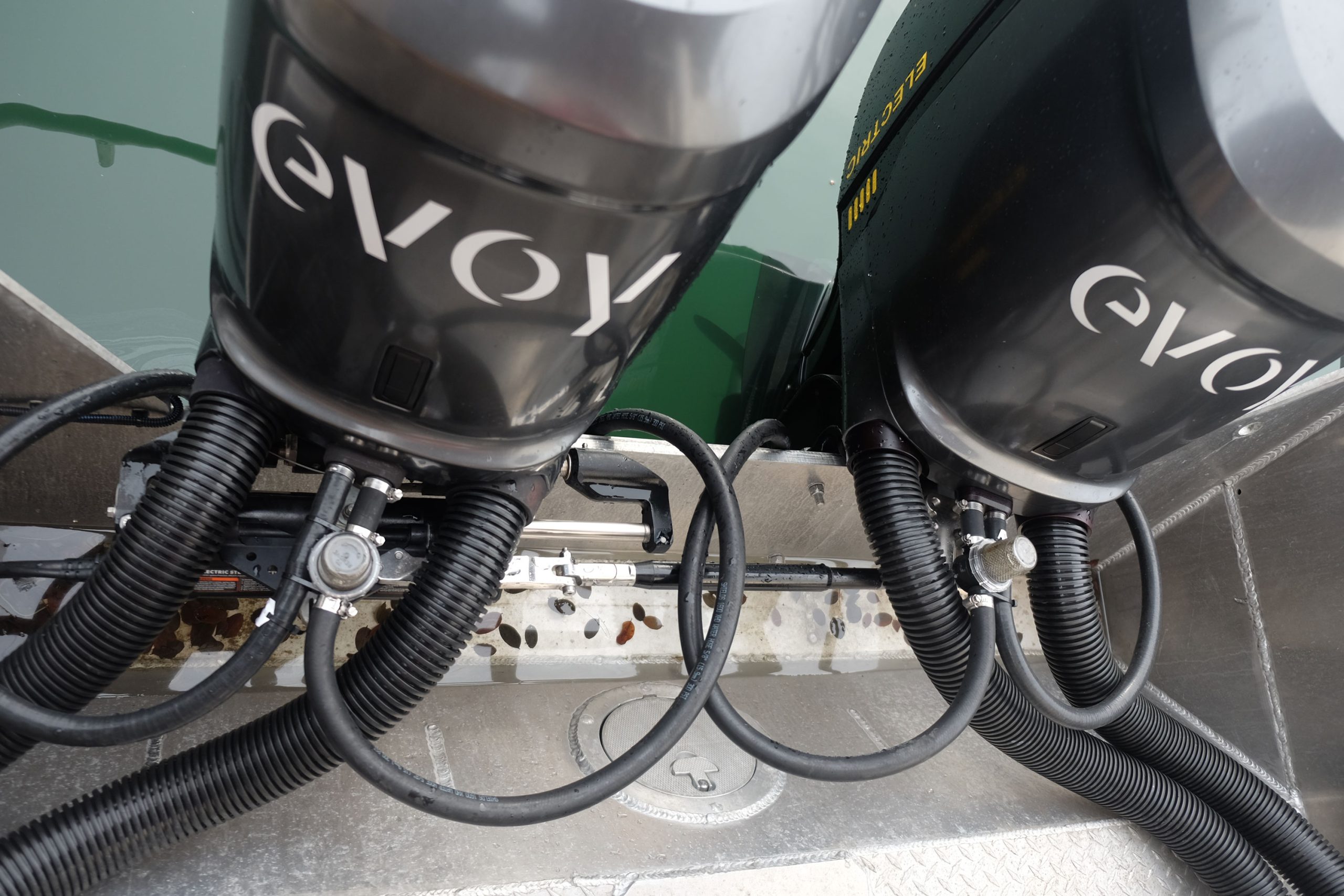
 Under their cowling, each Evoy 120+ outboard houses an electric powerhead as well as water pumps, filters, and heat exchangers to cool the motor and batteries.
While some partners suggested a production-built RIB would be adequate, Leathers insisted that the boat be customized for its intended service. “We were going to design the boat we wanted, then start making concessions to its electrification,” he said. That meant starting with an enclosed pilothouse for winter operation; a stable open work deck for harvesting, cleaning, and sorting oysters; the ability for carry a payload of 4,000 pounds (1,814.4 kg) of ice and oysters; cruise speed of 16-plus knots; the capacity to be Coast Guard certified; and a 30- to 40-year working life. “I came to Patrick with a Word document and said, ‘This is what I’m looking for.’ And he came back with a preliminary hull shape. I went back with house shape and then layout—he synthesized all of that,” Leathers said. The basic form of the final boat is a 28′ x 11′ x 1′ 10″ (8.5m x 3.4m x .5m) bluff-bowed landing craft.
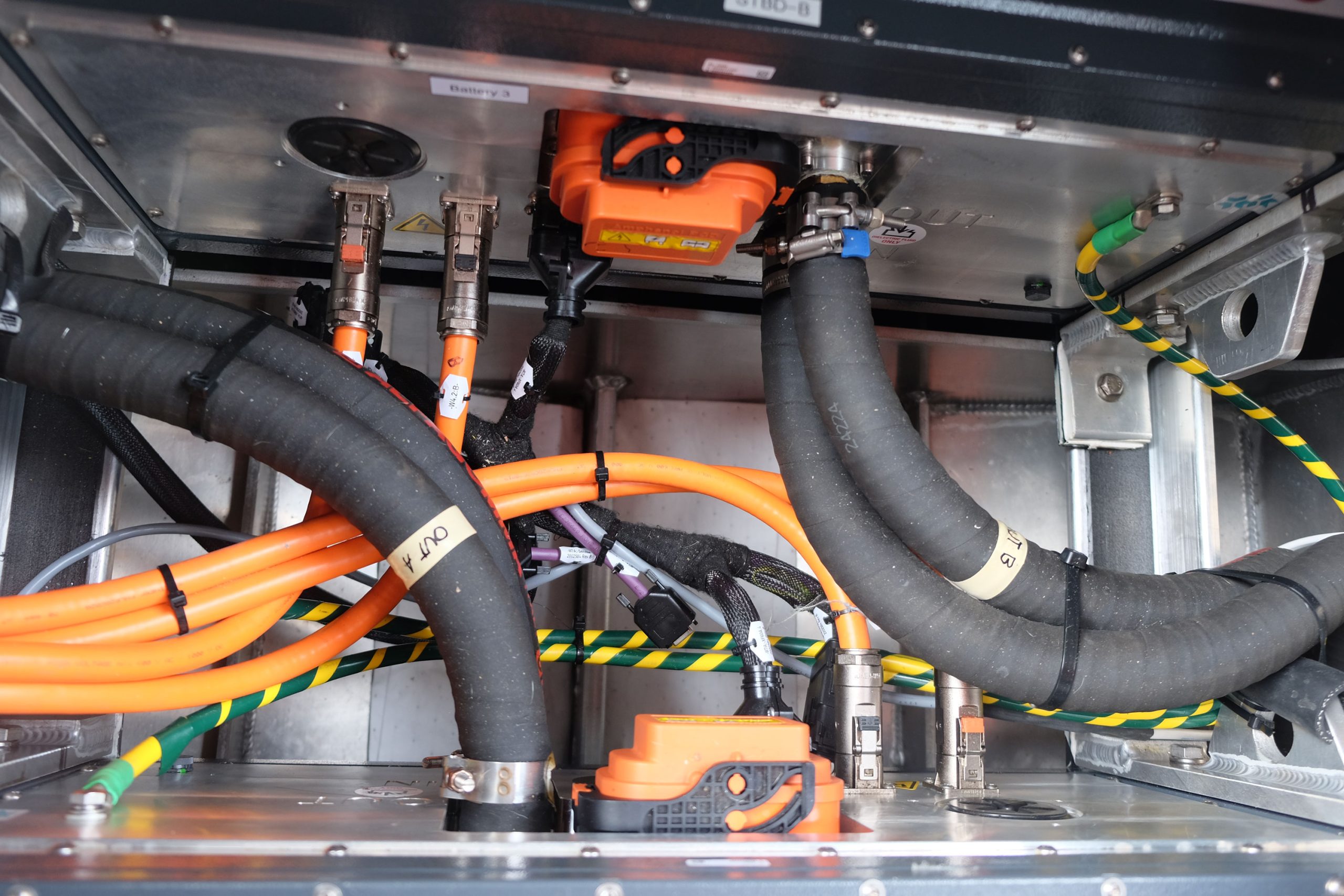
“I always thought that would be a really great platform for these oyster guys, and just a good workboat in general,” Patrick said. Consequently, he had one roughly designed that he was able to refine into the boat that would become Heron. Leathers said one of the greatest challenges for the designer was trimming the hull appropriately with a permanent installation of two 4′ x 3′ x 14″ (1.2m x .9m x .4m) 800-lb (362.9-kg) lithium-ion batteries and a movable working payload of oysters and aquaculture gear. The boat would have to run well loaded or light, which meant the batteries would have to be centrally located but preferably not directly under the wet work deck. Patrick’s solution was to install them under the 8′ (2.4m) pilothouse, which has a small service hatch in the sole providing access to electrical and cooling-system connections on the working ends of both batteries. To load them, each battery was lowered through the large hatch in the work deck and slid aft into place on a rack system under the pilothouse. Removal would require pulling a soft patch in the bulkhead aft of the large hatch, Leathers said.
 Brendan Bullock, Courtesy MOF
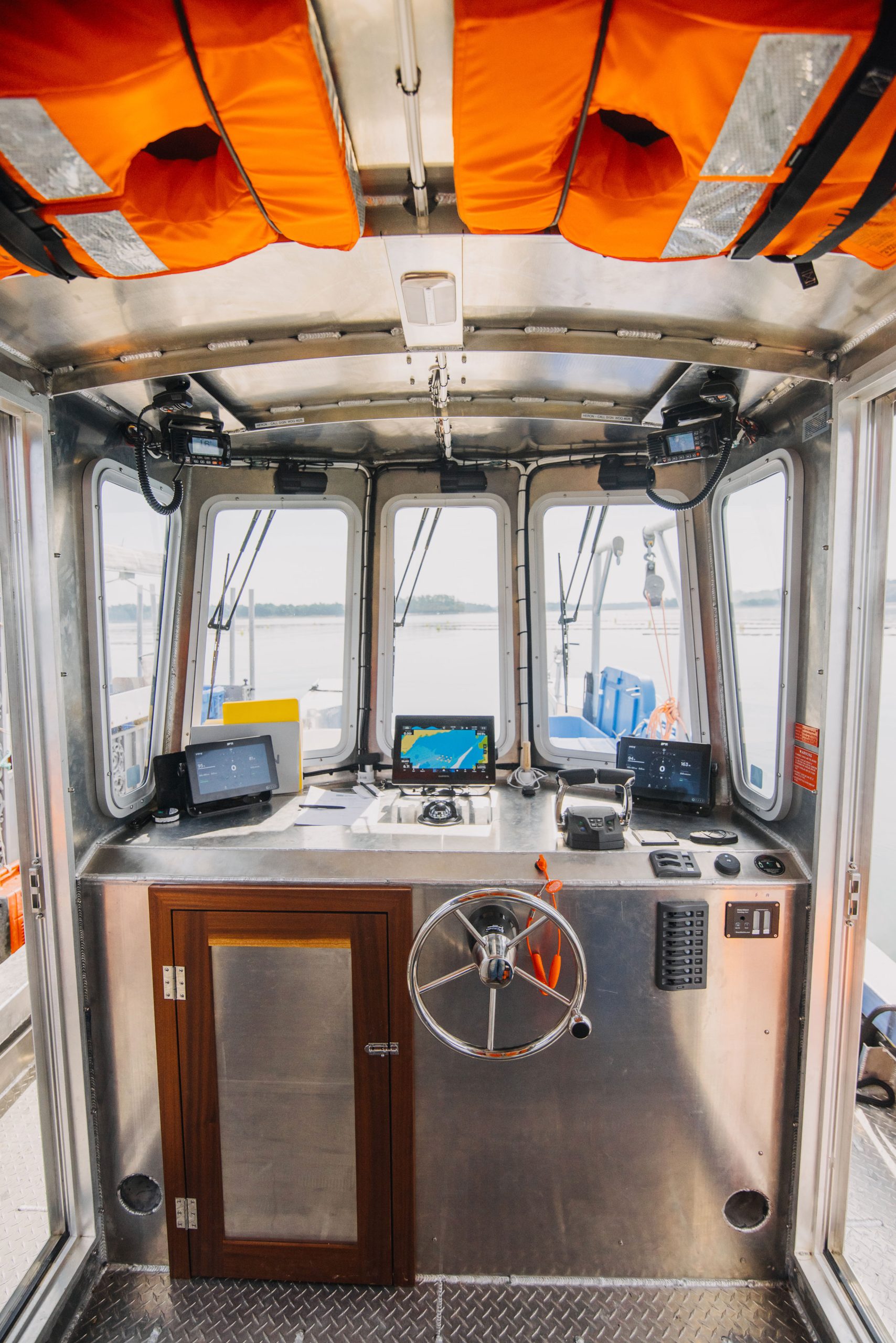
 Heron‘s ample and protected pilothouse provides good sight lines over the forward work deck.
 Aaron Porter
 A hatch in the pilothouse sole grants access to electrical connections and cooling inputs for the boat’s two 800V batteries.
In the space under the 12′ x 10′ (3.7m x 3m) work deck is storage area and two 20-gallon (75.7-liter) tanks—one for fresh water and one for wastewater—serving a marine head housed in a tiny cabin at the aft end of the pilothouse. Leathers wanted the head for workers who would be on the boat all day at the oyster farm and potentially for passengers touring the farm.
With passenger carrying in mind, the boat—including its 12V house electrical system—was designed and built to inspectable standards. But Leathers said he hasn’t applied for Coast Guard certification knowing the fire-suppression requirements for the lithium-ion batteries are still being hammered out, and some components in the European-built outboards would likely need to be altered to meet U.S. standards.
Patrick said scantlings on Heron reflect T-boat standards with transverse frames coming through the deck and supporting the bulwarks and side decks. The standard hull plating is ¼” aluminum on 3/8″ frames and a 3/4″ x 5″ center vertical keel. They used 5086 and 5083 alloy throughout. Fogg’s relies on TIG welding to minimize the need to clean up seams afterward. Patrick explained that he also sends some cut plates out to a bending shop to set clean right angles in structural frames and other components wherever he can eliminate welds.
Leathers praised Patrick’s attention to custom details such as a minimalist ladder to the pilothouse roof, a towing bit, davits, a hinged door section in the starboard topsides, and the break in the deck between the work deck and pilothouse level—an element Leathers insisted upon.
 Jack Sullivan, Courtesy MOF
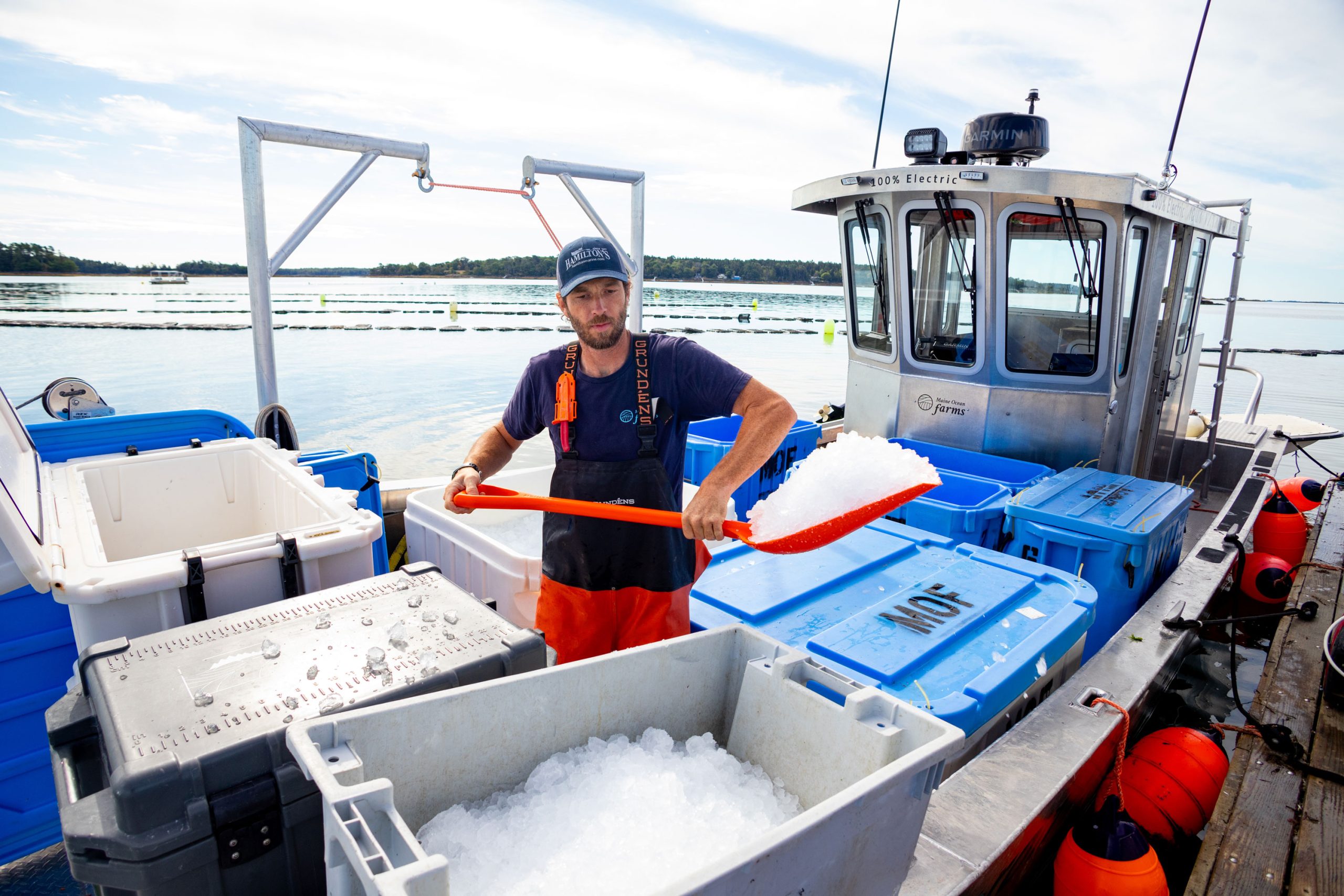
 Heron can accommodate 4,000 lbs (1,814.4 kg) of ice and oysters on her work deck and still run at 16 knots.
With electric outboards, there are no fuel tanks, filters, and pumps, but there are still cooling requirements for the electric motors and the batteries. Under the cowling of each Evoy outboard are two heat exchangers, water strainers, a water pump, and an electric motor, all bolted to an aluminum substructure. Below that are a standard mid-leg shaft and a lower unit from a gasoline outboard manufacturer. I was on board one of the first mornings there was snow on the ground and Leathers was concerned about what maintenance protocol and judicious application of nontoxic antifreeze would be necessary to keep the seawater intake and filters for the heat exchangers from freezing through winter service.
Under Way
“This boat is expected to shift gear at scale and speed,” Leathers said. But his definition of speed is specific to the boat’s refined use profile. “Most of our operations are going to be at low speed. All I care is that I get the right amount of power when I need it and get something that performs the way we want it to.”
With 126 kWh of battery power to draw on, he must be mindful of how he uses it. The 9,500-pound (4,309.1-kg) boat with a moderate 15° deadrise aft will get up on plane quickly and run at 20-plus knots in a chop, but not for long. While the low energy density of even the best lithium chemistry batteries limits high-speed operation, at six knots, Heron has a theoretical range of 90 miles. Standard operation, according to Leathers, is a 3-mile (4.8-km) roundtrip with ice, crew, and gear from a slip on the Harraseeket River in Freeport to the oyster farm, running at 7 knots. While working on site, energy draw for the motors is minimal, as most harvesting and shifting oyster gear are low-speed operations. They unload the 4,000 lbs. of harvested oysters and ice at the dock and drive them by truck to the shellfish dealer in Portland.
 Aaron Porter
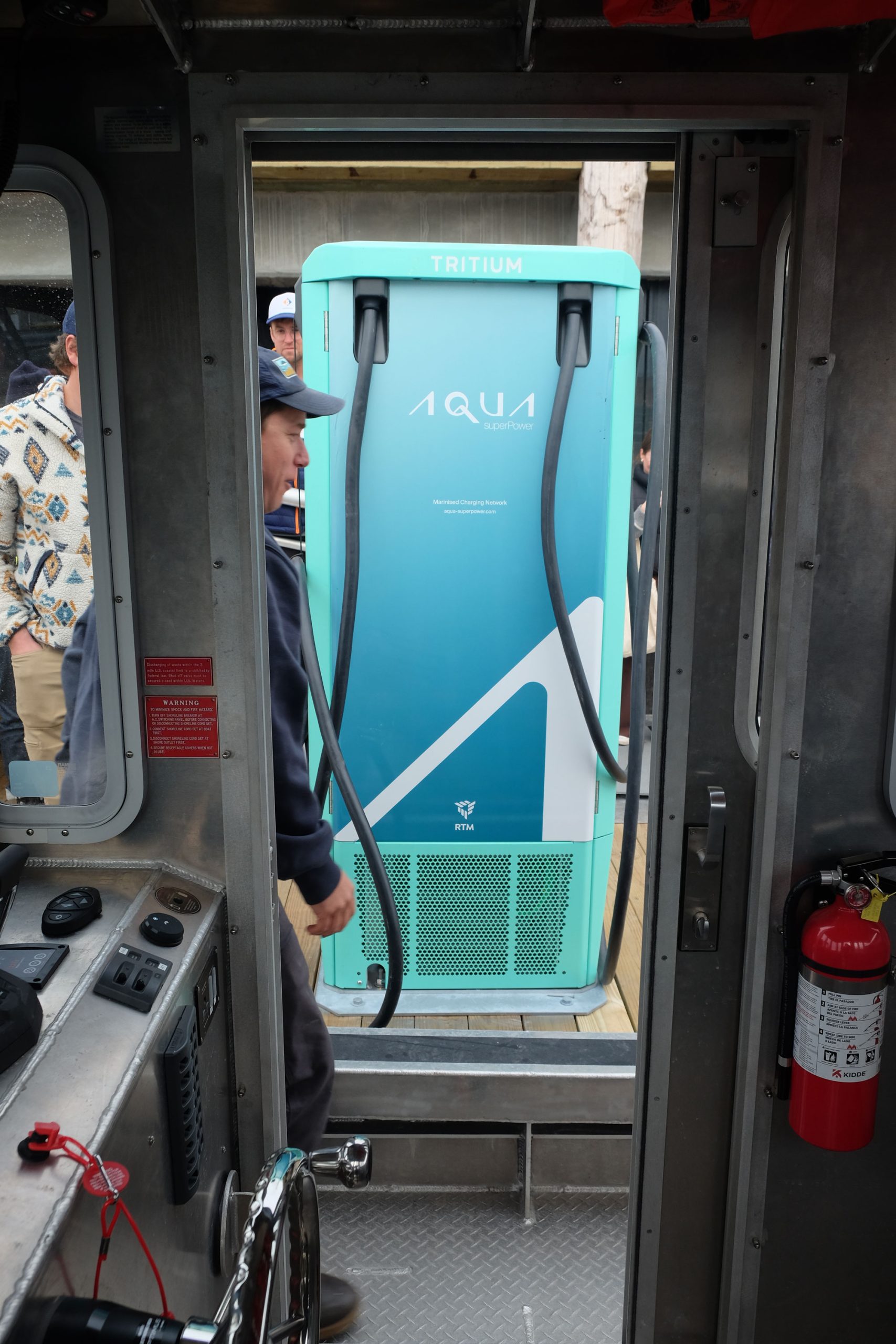
 Willy Leathers pulls Heron up to the new level-3, 75 kWh dockside charger at the Gulf of Maine Research Institute’s Wright’s Wharf facility in Portland, Maine.
On the day I joined Leathers, we were exploring a new option: the new level-3, 75 kWh charger in Portland. It would allow him to avoid the seasonal bottleneck at the dock in Freeport and deliver oysters directly to the Portland waterfront after harvesting them. He estimated the 12-mile (19.3-km) run fully loaded at 16 knots, on top of the energy consumed in harvesting, would bring his charge down to 20%—too little to make the trip back to the Harraseeket. But about an hour on the fast charger would bring the batteries back to between 50% and 75%—plenty to get home. All he needs to make it work is some task or distraction on the Portland waterfront to consume an hour of his time on every harvest day while the batteries charge. It’s a reminder that as well as you design and build with the technology at hand, sometimes you have to adjust the job slightly to optimize the refined tool you’ve created.
 Courtesy Fogg’s Boatworks
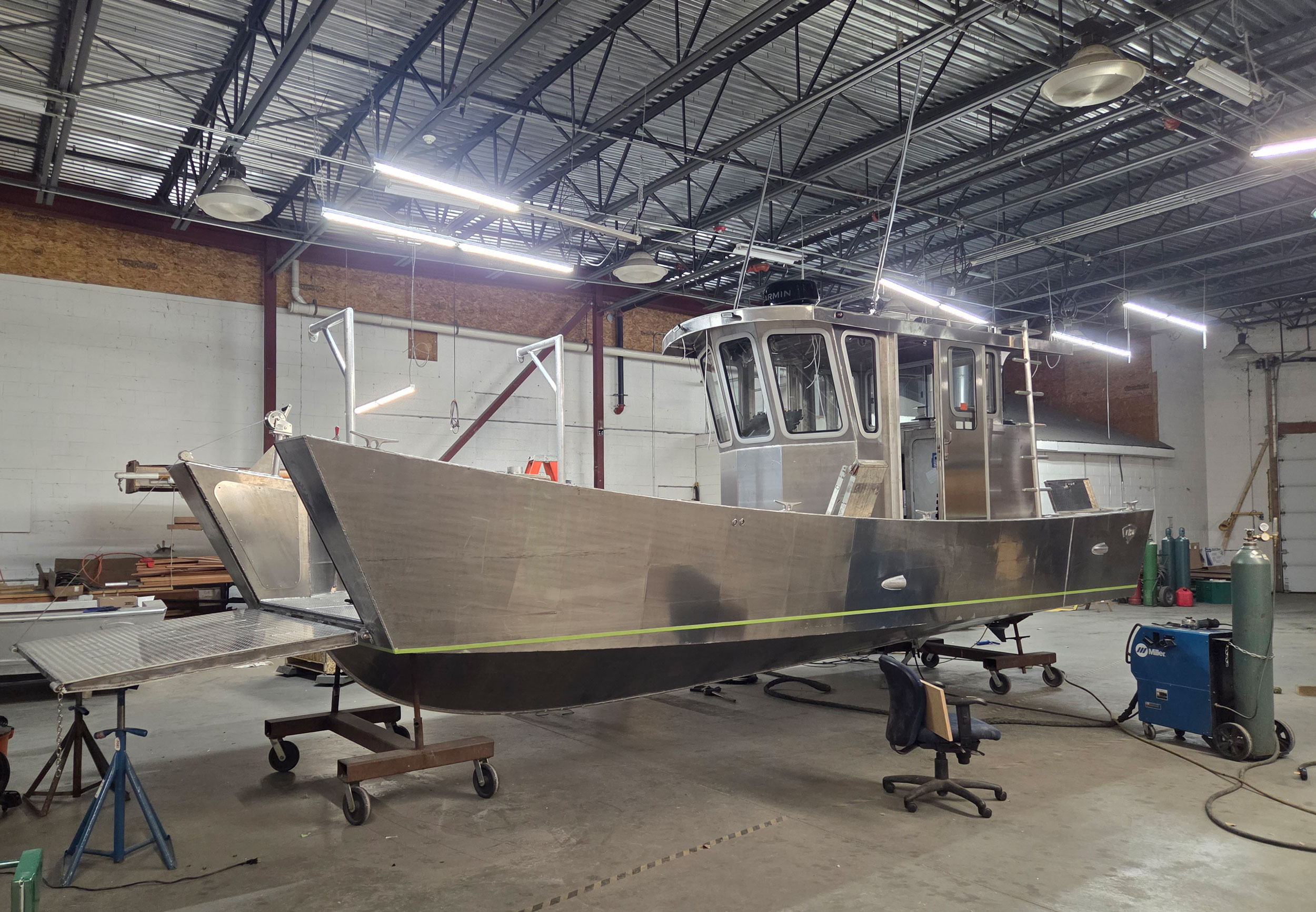
 Heron Particulars
Length: 28′ (8.5m)
Beam: 11′ (3.4m)
Draft: 1′ 10″ (.5m)
Weight: 9,500 lbs. (4,309.1 kg)
Propulsion: Evoy Vita twin outboard electric motor (2x 120+ HP)
Battery: 126kWh Lithium-ion
Use Case: Heavy-duty aquaculture—gear transport, harvesting, crew ops
Builder: Fogg’s Boatworks (Maine, USA)
Build: Aluminum